The Creative Solution to America’s Senior Housing Crisis
The Senior Housing Shortfall America is on the brink of a senior housing shortage as the Silver Tsunami approaches. Baby Boomers age into retirement, demand for high-quality, affordable senior living options is soaring — but supply isn’t keeping up. The National Investment Center for Senior Housing & Care (NIC) projects a shortfall of 550,000 senior […]


- NIC projects a shortfall of 550,000 senior housing units by 2030, requiring new construction to rise to more than three-and-a-half times its current pace.
- Adaptive reuse is expected to grow 35% by 2030; it already represents an estimated 3u20135% of U.S. senior housing communities, home to 80,000u2013150,000 seniors.
The Senior Housing Shortfall
America is on the brink of a senior housing shortage as the Silver Tsunami approaches. Baby Boomers age into retirement, demand for high-quality, affordable senior living options is soaring — but supply isn’t keeping up.
The National Investment Center for Senior Housing & Care (NIC) projects a shortfall of 550,000 senior housing units by 2030. To meet demand, new construction would need to increase to more than three-and-a-half times its current pace.
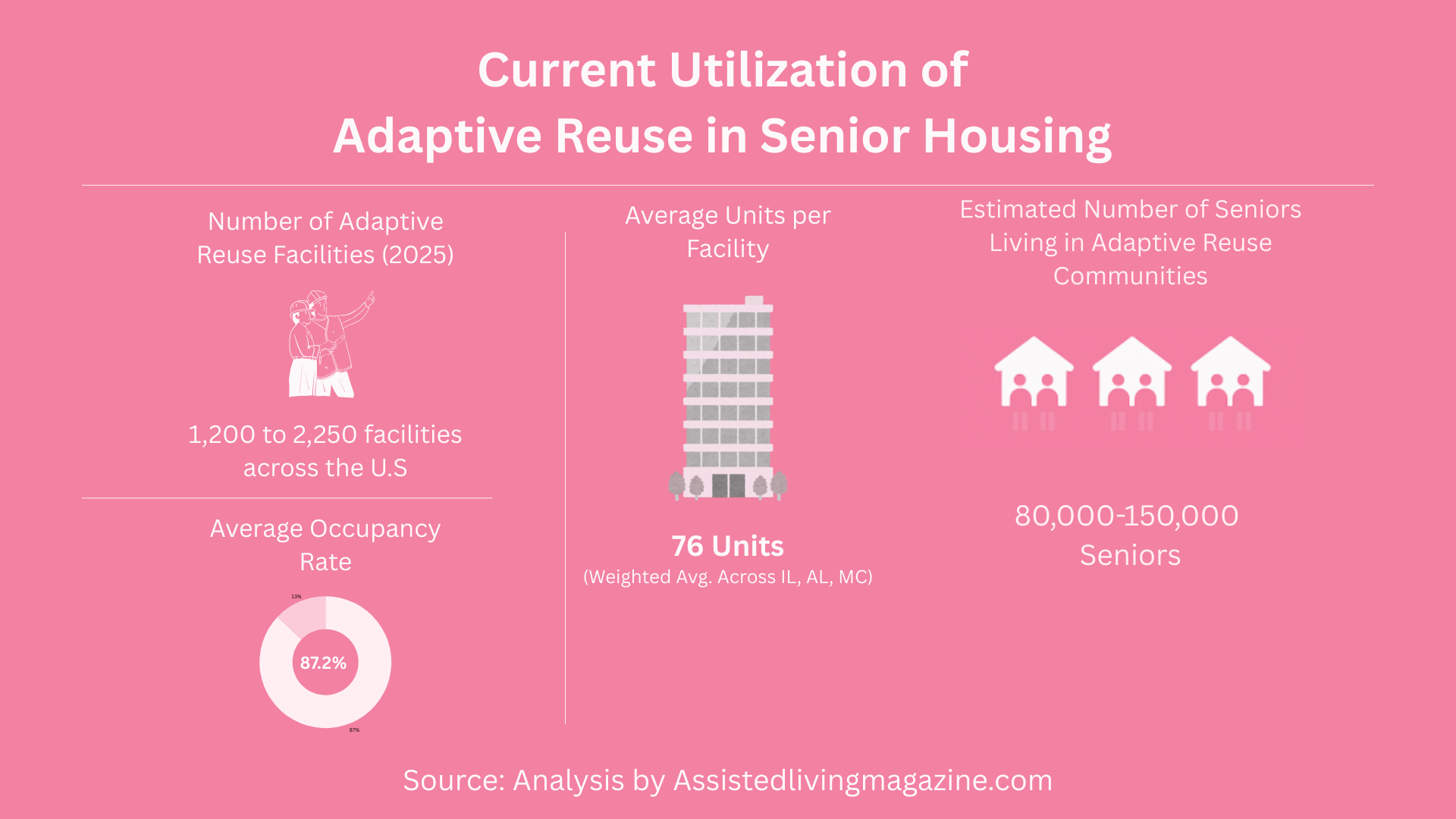
With occupancy rates hitting 87.2% in Q4 2024 — the thirteenth straight quarter of growth — the pressure on developers is intensifying. Unfortunately, traditional ground-up construction is slow, expensive, and often impractical for keeping pace with this demand.
That’s where adaptive reuse comes in.
What is Adaptive Reuse in Senior Housing?
Adaptive reuse is the process of converting an existing building — such as a school, hotel, hospital, church, or even a shopping mall — into senior housing.
This approach offers several benefits:
- Speed: Conversions are often faster than building from scratch.
- Cost savings: Reusing structures can reduce material and labor costs.
- Historic preservation: Many adaptive reuse projects save culturally significant buildings.
- Sustainability: Repurposing reduces demolition waste and environmental impact.
According to SL Investors, adaptive reuse in senior housing is expected to grow 35% by 2030. Assisted Living Magazine estimates that 3–5% of all senior housing communities in the U.S. today are adaptive reuse properties — roughly 1,200 to 2,250 communities.
How Many Seniors Live in Adaptive Reuse Communities?
Using an average of 76 units per community and the national occupancy rate of 87.2%, we estimate that 80,000–150,000 seniors currently live in adaptive reuse senior housing across the United States.
These communities include a mix of:
- Independent Living (IL): ~115 units per property on average
- Assisted Living (AL): ~65 units per property
- Memory Care (MC): ~40 units per property
| Facility Type | Approx. Share of Total Senior Housing Facilities |
| Assisted Living (AL) | ~55% |
| Independent Living (IL) | ~ 30% |
| Memory Care (MC) | ~15% |
Spotlight: Adaptive Reuse Success Stories
Here are just a few examples of creative conversions meeting the needs of seniors today:
The Newbury of Brookline, MA
- Formerly: Newbury College
- Now: IL, AL, MC community with 159 units
- Notable: Preserved historic campus charm
Tiger Senior Apartments, Paris, IL
- Formerly: Paris High School (1909)
- Now: 42 affordable senior units
- Notable: Retained original gymnasium and auditorium
Courtyard Luxury Senior Living, Clinton, NJ
- Formerly: Holiday Inn (closed during COVID-19)
- Now: 134 total units (AL, MC, Affordable Housing)
- Notable: Amenities include a saltwater pool, movie theater, and on-site pharmacy
Bardwell Residences, Aurora, IL
- Formerly: Old Copley Hospital
- Now: 99 IL, AL, MC units
- Notable: $130M rehab transformed a community eyesore
Skyview Park Apartments, Irondequoit, NY
- Formerly: Sears store in Irondequoit Mall
- Now: 157 senior units (55+)
- Notable: First mall-to-senior housing conversion in New York State
In Development: What’s Coming Next
The pipeline for adaptive reuse in senior housing is growing, with projects in malls, office buildings, and churches slated to open in the next few years. Examples include:
- Sophia at Hawthorn Mall (Fall 2025) – 166 units in a former shopping center in Illinois
- Sophia at Fox Valley Mall (Fall 2025) – 204 units, also in Illinois
- Larson Building, Eden Prairie, MN (2026) – 24 units in a converted office building
Why Adaptive Reuse Matters
Adaptive reuse is not just an interesting architectural trend — it’s a critical strategy for meeting senior housing needs. By creatively repurposing existing spaces, we can:
- Add housing supply faster
- Provide affordable options for low- and middle-income seniors
- Preserve historic and culturally significant structures
- Support sustainability goals
With an aging population and limited buildable land, adaptive reuse could become one of the most important tools in the senior housing industry’s future.