

We Learned to Live Longer. Can We Learn to Age Better?
The greatest achievement in longevity is not that a few people now live past 100. It is that reaching old age has become ordinary. The next challenge is less about adding years to the human lifespan than about what people can do and enjoy during those years, including when they need help. The BBC recently […]


- The global gap between life expectancy and health-adjusted life expectancy widened from 8.5 years in 2000 to 9.6 in 2019; the U.S. gap was 12.4 years.
- Researchers found life-expectancy gains have generally slowed since 1990, and radical extensions of average lifespan this century are unlikely without major advances slowing biological aging.
- Accessible homes, caregivers, transportation and community support can help older adults preserve autonomy, relationships and valued activities even when illness or disability occurs.
The greatest achievement in longevity is not that a few people now live past 100. It is that reaching old age has become ordinary. The next challenge is less about adding years to the human lifespan than about what people can do and enjoy during those years, including when they need help.
The BBC recently profiled the pursuit of a longer human life, reviving a question that has fascinated scientists for decades: How much longer can we live? As a researcher studying aging, I think the more urgent question is what those extra years will actually look like, and who will have the resources to live them well.
How Reaching Old Age Became Ordinary
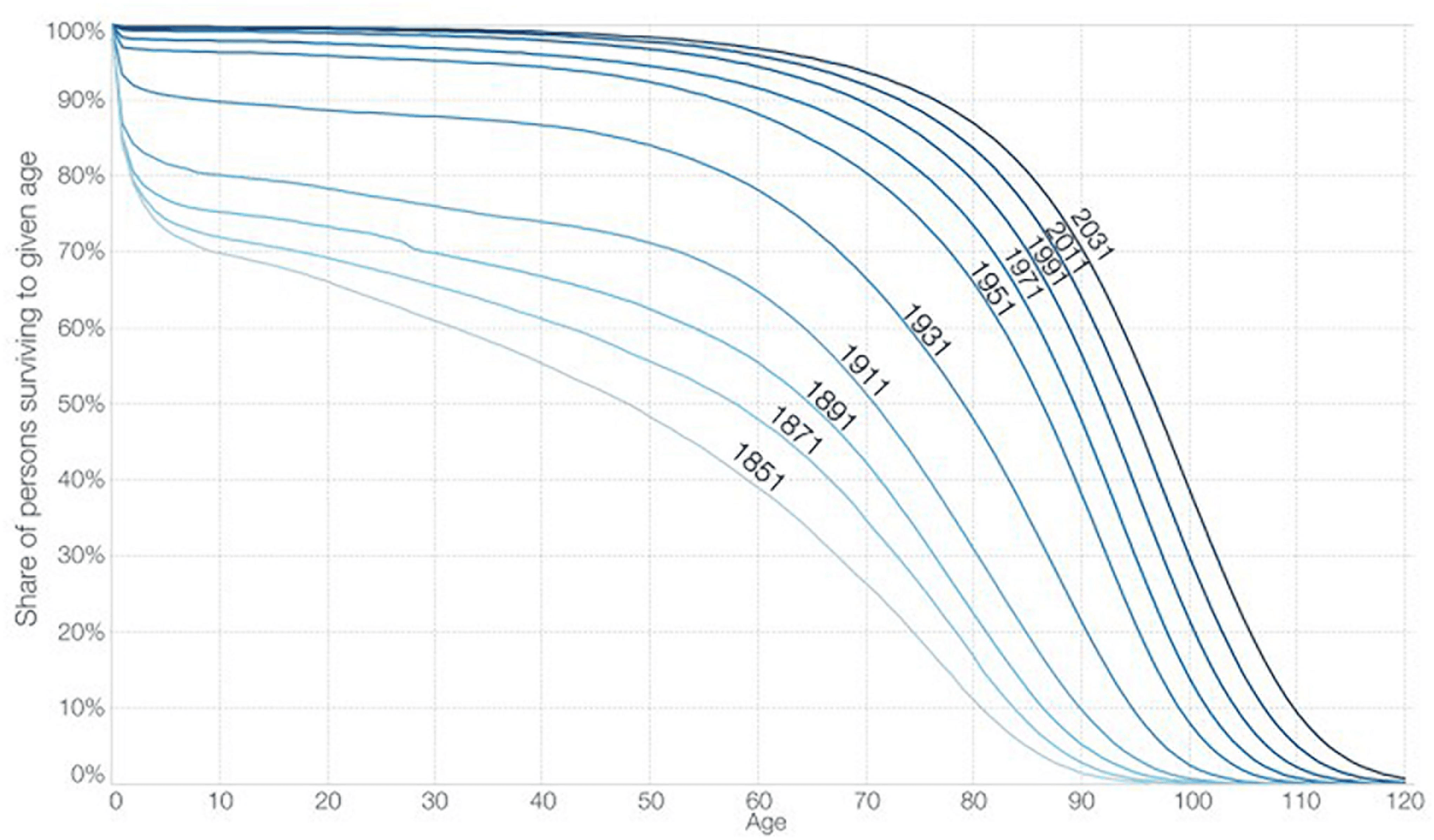
In England and Wales, fewer than half of those born in 1851 survived to their 50th birthday. For more recent generations, the expected proportion surviving to 50 exceeds 95 percent. A milestone once beyond the reach of much of the population is now something most people barely think about.
The change was not confined to childhood. Over successive generations, survival through middle age and into later life rose dramatically. In the nineteenth century, deaths were spread widely across the lifespan. Today, in high-income countries, they are concentrated much later. Demographers call the resulting shift the rectangularization of the survival curve.
That sounds abstract until you see the numbers. In the chart below, the earliest generations lose substantial numbers of people long before old age. Later generations remain near the top for decades. The lines do not simply move to the right; they take on a different shape. It is one of the clearest pictures of what sanitation, nutrition, public health and medical care have accomplished together.
Understanding the Gap Between Lifespan and Healthspan
But the chart leaves out something essential. It tells us whether people are alive, not how they are living.
Someone who reaches 85 with few health limitations appears exactly the same on a survival curve as someone who reaches 85 while managing substantial disability and receiving daily assistance. Both lives matter equally. What differs is the kind of care, support, and opportunity needed to live them on one’s own terms.
That distinction is becoming central to longevity research. Lifespan is the length of life. Healthspan concerns how much of it is spent in good health. The two do not necessarily increase at the same pace.
A 2024 study in JAMA Network Open, drawing on data from 183 countries, estimated that the global gap between life expectancy and health-adjusted life expectancy widened from 8.5 years in 2000 to 9.6 years in 2019. The United States had the largest estimated gap in the study, at 12.4 years. That is not a prediction that every American will spend a dozen years bedridden: health-adjusted life expectancy accounts for the burden and severity of illness and disability. Still, the trend exposes a difficult reality. More years of life do not automatically mean equally large gains in healthy years.
The Next Challenge for Longevity Science
There is another reason the next leap may be harder than the last. Much of the historical increase in life expectancy came from preventing deaths at younger ages, notably through reductions in infectious disease and early-life mortality. In longer-lived populations, further progress increasingly depends on preventing or postponing deaths associated with older age.
In a 2024 Nature Aging analysis of several of the world’s longest-lived populations, researchers found that improvements in life expectancy had generally slowed since 1990. Without major advances in slowing biological aging, they concluded, radical extensions of average human life are unlikely this century. That is a conclusion from observed population trends, not proof that future discoveries cannot change the trajectory.
Meanwhile, the science gives us reasons to think beyond the search for a single anti-aging treatment. Heart disease, stroke, diabetes, dementia and mobility limitations often develop together, sharing risk factors and sometimes reinforcing one another. Preventing disease matters, but so does making life with illness more manageable. A stroke survivor might need rehabilitation, accessible transportation or help at home to return to the activities and relationships that matter most.
The World Health Organization’s approach to healthy aging recognizes this. Health is not simply the absence of disease, and independence is not the only measure of a good later life. Healthy aging also depends on whether people can make decisions, maintain relationships and participate in their communities. Physical and cognitive abilities matter, but so do accessible homes, reliable caregivers, supportive neighborhoods and affordable services.
What This Means for Older Adults and Families
For families, this makes the longevity conversation more practical. The question is not only how to prevent the next diagnosis, but what might help someone keep doing the things they value. A hearing assessment may make conversations easier. A safer bathroom or a home without stairs may reduce obstacles to everyday routines. Transportation, a trusted care partner or flexible community programs may make it possible to see friends, attend an event or stay involved in family decisions. Support is not the opposite of autonomy; often, it is what makes autonomy possible.
These considerations also change what we should expect from longevity science. A treatment that extends survival deserves attention, but we should ask what happens to people’s functioning, wellbeing and need for support during those added years. Ideally, medical advances will improve both survival and quality of life. And when illness or disability cannot be avoided, better housing, care and social support can still make those years more meaningful.
The nineteenth-century survival curve tells a remarkable story: reaching old age ceased to be an exception for much of the population. The next achievement will be harder to draw as a single line. It will be found in the opportunities people retain, the decisions they can make, the relationships they can sustain and the support available as their needs change.
We have made living longer increasingly ordinary. Making longer lives better supported, more connected and more fully lived is the challenge ahead.