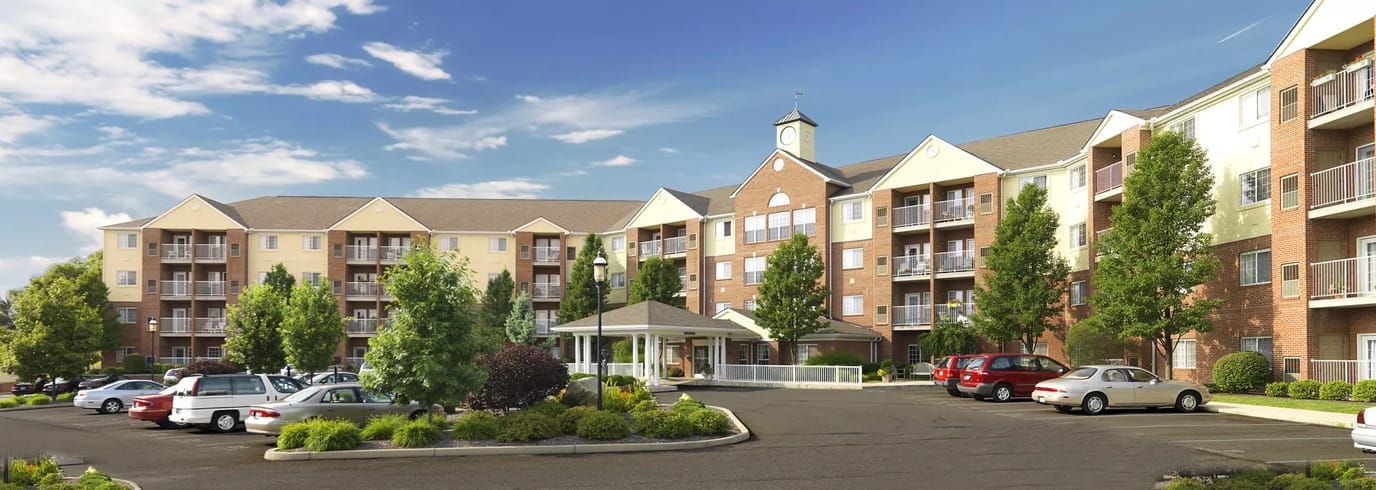
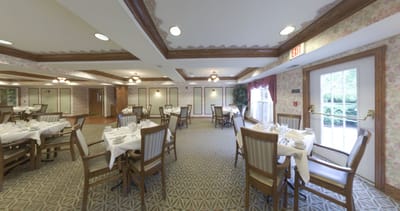

Medium-capacity home · Offers a balance of services and community atmosphere.
Carespring – Barrington of Fort Thomas
Carespring, Barrington of Fort Thomas offers nursing home and skilled nursing care, assisted living, independent living, continuing care retirement community services, and respite care in Fort Thomas, KY. Assisted living offers help with everyday activities while residents have their own private apartments; Nursing home and skilled nursing care include licensed nurses available 24 hours a day. Independent living features private apartments with community amenities but no regular care, and respite care allows for a brief stay when a family caregiver must be away or recover.
Several care levels are available in one community, which may suit a resident whose needs could grow over time and who may want to remain in the same community. The community has 110 beds and offers studio, one bedroom, and two bedroom residences; a studio is a single private space, while a two bedroom layout can suit a couple moving together. Total nurse staffing is 3 hours and 27 minutes per resident per day, representing the daily hands on nurse time allocated per resident.
Programs include skilled nursing and rehabilitation, long term nursing care, and hemodialysis, while short term rehabilitation supports a temporary, recovery focused stay. Payment options are Medicare, Medicaid, and private pay, giving families routes for short term skilled coverage, public assistance, or direct payment. Meals are centered on nutritious options, so residents rely on organized dining rather than preparing every meal themselves; with a Walk Score of 48, this area depends mostly on cars or rides for errands, meaning residents who don’t drive will need transportation for those outings.
Community insights.
About This Community
Pricing & Financial Information
The below pricing was updated on
- Group outings (museums, ballgames, mall, theater)
- Professionally designed exercise programs (individual and group)
- Landscaped Courtyards and Outdoor Common Areas
- Fitness center with recumbent bikes, exercise balls, and yoga mats
- In-room dining available.
- Diabetic-friendly options.
- Low-sodium / heart-healthy options.
Places of interest near Carespring – Barrington of Fort Thomas
1.0 miles from city center
Estimated distance in miles from Fort Thomas's city center to Carespring – Barrington of Fort Thomas's address, calculated via Google Maps.
Calculate Travel Distance to Carespring – Barrington of Fort Thomas
Add your location
Compare Nursing Homes around Covington
Info below is compiled from CMS reports & the KY Cabinet for Health & Family Services (CHFS), senior community websites & trusted data sources such as Walk Score & BBB.
Communities are listed from highest-ranked to lowest-ranked based on our methodology.
The facility name. Click to view the full profile page on Assisted Living Magazine, including photos, services, and contact info.
|
CMS (Centers for Medicare & Medicaid Services, the federal agency that regulates nursing homes) Overall 5-star rating — a composite of Health Inspection, Staffing, and Quality Measures scores. 5 stars = top 10% nationally. 1 star = bottom 10%. The single most important number to start with when comparing facilities.
|
Care Types in This Table
AL (Assisted Living):
Housing with help for daily activities like bathing, dressing, and medication, without 24-hour skilled nursing.
NH (Nursing Home):
24/7 skilled nursing care for residents with complex, ongoing medical needs.
SNF (Skilled Nursing Facility):
Round-the-clock nursing care, often for recovery after surgery, injury, or illness.
MC (Memory Care):
Secured, specialized care for people living with Alzheimer's or dementia.
HOS (Hospice Care):
Comfort-focused care for those with a terminal illness, prioritizing quality of life over treatment.
PC (Palliative Care):
Comfort-focused care for serious illness at any stage, including alongside curative treatment.
|
Neighborhood or city area where the facility is located. Proximity to family, hospitals, and green space matters for both quality of life and ease of visitation. Consider drive time and transit access when evaluating location.
|
Licensed bed capacity. Larger facilities (300+ beds) often have more specialized programs but can feel institutional. Smaller homes (under 150 beds) tend to deliver more personalized care. Compare with Avg Res/Day to understand how full the facility typically runs.
|
Percentage of licensed beds filled on an average day. Color indicates financial health: green (90%+) = operationally strong, typically profitable. Amber (80–89%) = stable but leaving revenue on the table. Orange (70–79%) = financial strain likely, may struggle with fixed costs. Red (
|
This facility's occupancy rate compared to the statewide average for similar facilities. A positive number means above-average demand. Facilities running 5%+ above the state average are typically the most sought-after in their market — a strong proxy for reputation.
|
CMS-adjusted total nurse hours per resident per day (RN + LPN + CNA combined). The national average is approximately 3.5 hrs. Higher is better — more direct care time per resident. Below 3.0 is a red flag. CMS weights RN hours more heavily because RNs handle complex clinical decisions that CNAs cannot.
|
CMS Health Inspection star rating (1–5 stars), based on the 3 most recent annual state surveys plus any complaint investigations. This is the hardest rating to manipulate — it reflects real surveyor findings on-site. 5 stars = fewest deficiencies found. 1 star = most. It carries the heaviest weight in the Overall CMS rating.
|
CMS Staffing star rating (1–5 stars), based on daily nurse staffing hours submitted to CMS via verified payroll data. Compares RN, LPN, and CNA coverage relative to resident acuity level. 5 stars = well above expected staffing. Weekend staffing is evaluated separately, as that's where many facilities quietly reduce coverage.
|
CMS Quality Measures star rating (1–5 stars), based on 15 clinical outcome metrics including fall rates, pressure ulcers, antipsychotic drug use, and hospital readmissions. Captures actual resident health outcomes, not just compliance. High QM combined with low Health Inspection scores can indicate a facility with strong care but weak documentation practices.
|
Registered Nurse hours per resident/day compared to the statewide average. RNs are the highest-skilled nursing staff — they assess residents, manage medications, and respond to emergencies. A value of +50% means RN coverage is 50% above the state norm. Negative values are a concern for residents with complex or acute medical needs.
|
Total nursing staff hours (RN + LPN + CNA combined) per resident/day vs. the statewide average. A broader measure than RN vs State — it captures the entire care team. A facility can have high total staffing but low RN hours, meaning more aides and fewer nurses. Read both columns together for the full picture.
|
Total dollar amount of federal monetary fines (civil money penalties) issued by CMS in the past 3 years. Fines are only levied for serious violations — typically actual harm to residents, repeated uncorrected deficiencies, or systemic non-compliance. Even a single fine is noteworthy. Multiple fines strongly suggest a pattern, not isolated incidents.
|
Total health deficiency citations from the most recent standard inspection cycle. Minor citations (scope A–C) are common and often administrative in nature. Higher counts aren't always disqualifying, but should be read alongside Severe Citations to understand actual harm levels. Under 10 is strong for a large facility; 30+ warrants a closer look.
|
Average deficiency citations per CMS inspection (survey) in the reporting window — total citations divided by the number of inspections. Lower is better; compare alongside total Citations and Severe Citations for context.
|
Citations at CMS scope/severity level G or higher — G–I means actual harm occurred; J–L means residents were placed in immediate jeopardy. (D–F is potential for harm only). Examples include unaddressed falls, medication errors causing injury, neglect, or abuse.
|
Average number of residents in the building on any given day, derived from annual census data. Reflects true operating scale — a 400-bed facility running 200 residents/day operates very differently from one at 390. Higher resident counts generally mean more funded staffing hours.
|
Better Business Bureau rating (A+ to F). Reflects complaint history, business transparency, and how family disputes were resolved. A+ means no significant unresolved complaints. A blank (—) means the facility isn't BBB-accredited, which is common for healthcare providers and not necessarily a negative signal.
|
Walk Score® (0–100). Measures walkability of the surrounding area. 90–100 = Walker's Paradise. 70–89 = Very Walkable. 50–69 = Somewhat Walkable. Below 50 = Car-Dependent. Higher scores benefit family visitors, resident outings, and staff commuting.
|
The licensed owner or operator of record filed with CMS — the individual or organization legally accountable for the facility. Searching the operator name across other facilities can reveal chain or multi-site ownership, which matters: chain-operated homes tend to have more variable quality outcomes than independently run facilities.
|
What the home actually collects for resident care, after contractual allowances, bad debt and discounts — not gross billings. Taken from the latest complete annual cost report, so it is comparable across homes reporting the same period. Revenue alone doesn't indicate care quality, but it funds staffing and capital reinvestment. Pair with Payroll %. Figures are from each facility's most recent complete fiscal year — hover a value for the exact year; a * marks homes that report an older period than most facilities.
|
Staff salaries plus wage-related benefits from the latest complete annual cost report. Contract and agency labour is counted separately, under other operating costs, so a home leaning on agency staff can show a low figure here. Payroll is the cost most directly tied to care quality — compare with Payroll % for full context. Figures are from each facility's most recent complete fiscal year — hover a value for the exact year; a * marks homes that report an older period than most facilities.
|
Payroll as a share of NET PATIENT REVENUE (not gross revenue). Both figures come from the same cost-report year. A higher figure means more of each revenue dollar goes to staff pay. Read with the Staffing star rating to judge whether spend translates into coverage — and note that homes whose patient revenue covers only part of their operation can read implausibly high. The Kentucky average is: 45.8% Figures are from each facility's most recent complete fiscal year — hover a value for the exact year; a * marks homes that report an older period than most facilities.
|
CMS Certification Number: the unique federal identifier for this skilled nursing provider.
|
|---|---|---|---|---|---|---|---|---|---|---|---|---|---|---|---|---|---|---|---|---|---|---|---|---|
| Rosedale Green | NH HOS MC PC SNF | Covington | 191
Facility
191
KY AVG
98
Rank
#6 / 195 | - | - | 4.00
Facility
4.00
KY AVG
3.76
Rank
#30 / 189 | -45% | +6% | $0
Facility
$0
KY AVG
$40.2k
Rank
#1 / 192 | 7
Facility
7
KY AVG
12.0
Rank
#51 / 191 | 3.5
Facility
3.5
KY AVG
4.1
Rank
#87 / 191 | 2 | 167 | - | - | Kenton Housing, Inc | $20.4MFiscal year ending 12/2024
Facility
$20.4MFiscal year ending 12/2024
KY AVG
$11.4M
Rank
#8 / 186 | $10.0MFiscal year ending 12/2024
Facility
$10.0MFiscal year ending 12/2024
KY AVG
$5.2M
Rank
#11 / 186 | 48.8%Fiscal year ending 12/2024
Facility
48.8%Fiscal year ending 12/2024
KY AVG
45.8%
Rank
#62 / 186 | 185225 | ||||
| The Pavilion at Kenton | NH AL SNF | Covington (Wallace Woods) | 82
Facility
82
KY AVG
98
Rank
#126 / 195 |
88.7%
Facility
88.7%
KY AVG
87.5%
Rank
#100 / 162 | +1% | 2.68
Facility
2.68
KY AVG
3.76
Rank
#173 / 189 | -21% | -29% | $0
Facility
$0
KY AVG
$40.2k
Rank
#1 / 192 | 34
Facility
34
KY AVG
12.0
Rank
#184 / 191 | 8.5
Facility
8.5
KY AVG
4.1
Rank
#180 / 191 | 2 | 73 | - |
54
Facility
54
KY AVG
46
Rank
#76 / 204 | Pavilion At Kenton For Nursing And Rehabilitation, LLC | $10.9MFiscal year ending 12/2024
Facility
$10.9MFiscal year ending 12/2024
KY AVG
$11.4M
Rank
#90 / 186 | $4.5MFiscal year ending 12/2024
Facility
$4.5MFiscal year ending 12/2024
KY AVG
$5.2M
Rank
#98 / 186 | 41.4%Fiscal year ending 12/2024
Facility
41.4%Fiscal year ending 12/2024
KY AVG
45.8%
Rank
#124 / 186 | 185038 |
Rank badges are statewide and care-type specific: each nursing home is ranked against every other KY nursing home we track that reports that metric, not just the 2 on this page. See how we rank facilities
Programs that may help with care and living costs in Kentucky
Carespring – Barrington of Fort Thomas is in Fort Thomas, Kentucky. These programs may support different care settings or living expenses. A listing does not confirm this community participates; our concierge team can help confirm.
VA Aid and Attendance (A&A) and Housebound Benefits
VA Pension Aid and Attendance and Housebound Benefits (Federal)
- Who it is for
- Veterans or survivors with VA pension eligibility and an Aid and Attendance or Housebound medical need
- Income limit
- No single monthly income cutoff. VA compares countable annual income, after permitted deductions, with the applicable Maximum Annual Pension Rate for the household and benefit category.
- Asset limit
- Net-worth limit is $163,699 from December 1, 2025 through November 30, 2026. Net worth includes countable assets plus annual income; exclusions and transfer rules apply.
Eligibility
- General
- Veterans or eligible survivors who qualify for VA Pension or Survivors Pension and meet the additional Aid and Attendance or Housebound criteria. Service, discharge, family status and pension eligibility rules also apply.
- KY specifics
- A federal VA pension benefit; Aid and Attendance and Housebound enhancements cannot be received together.
What it provides
- A higher pension ceiling for eligible Aid and Attendance or Housebound recipients. Actual pension equals the applicable annual maximum minus countable income; the two enhancements cannot be paid together.
Optional State Supplementation
Kentucky Optional State Supplementation
Eligibility
- General
- Eligible Kentucky adults who are aged, blind or disabled, meet the applicable financial and technical rules, need a full-time qualifying living arrangement and have insufficient income for the payment standard.
- KY specifics
- Personal/family care home and caretaker categories require age 18 or older. Eligibility and payment depend on the specific category.
What it provides
- Supplemental payments for qualifying personal care homes; family care homes or approved caretaker arrangements; separate criteria govern community integration supplementation.
Home and Community Based Waiver
Kentucky Medicaid HCB Waiver
Eligibility
- General
- People age 65 or older or with a physical disability who meet Kentucky Medicaid and HCB waiver functional requirements.
- KY specifics
- Service approval is based on assessed needs and current waiver policy; no flat daily hours are established.
What it provides
- Authorized supports such as adult day health; personal care; respite and other HCB waiver services.
Hart-Supported Living Program
KY Hart-Supported Living
Eligibility
- General
- Kentucky residents with qualifying disabilities seeking supports for community living, under Hart-Supported Living eligibility rules.
- KY specifics
- The program supports integrated living and individual control; segregated or certain congregate models are excluded.
What it provides
- Approved grants for supports that promote community living; independence and inclusion.
Kentucky Homecare Program
Eligibility
- General
- Age 60 or older with the stated ADL/IADL limitations and institutional-care risk, or able to leave an institution for home with support.
What it provides
- Coordinated home supports for daily needs; according to assessment and program authorization.
Family Caregiver Support Program
Family Caregiver Support Program (Kentucky)
- Who it is for
- Family or informal caregivers of an adult 60+ or of someone of any age with dementia
Eligibility
- General
- Adult family or informal caregivers of adults age 60 or older or people of any age with Alzheimer's disease or a related disorder. The federal program also supports specified older-relative caregiver categories.
What it provides
- Caregiver information and access assistance; counseling and training; support groups; respite and limited supplemental services under the federal caregiver-support framework.
Kentucky Family Caregiver Program
- Income limit
- Household income at or below 150% of the federal poverty level.
Eligibility
- General
- Grandparents who are primary caregivers of a grandchild age 18 or younger living in the same home; the child's parents must not reside in the household.
- KY specifics
- This is a grandparent-caregiver program, not a general elder-care grant.
What it provides
- Information; support groups; counseling and training; eligible participants may receive grants or vouchers for approved child-related expenses.
Kentucky Transitions
Kentucky Kentucky Transitions
Eligibility
- General
- Older adults or people with qualifying disabilities who have lived in a nursing facility at least 60 days, meet Medicaid requirements, receive Medicaid-paid services at least one day before referral and can live in the community with support. Some stay exclusions apply.
What it provides
- Transition planning; help locating affordable housing and connections to approved community supports and Medicaid waiver services.
Personal Care Attendant Program (PCAP)
Kentucky Personal Care Attendant Program (PCAP)
Eligibility
- General
- Adults age 18 or older with qualifying severe physical disability, including the statutory functional loss of two or more limbs, who need at least 14 hours of assistance weekly or a nighttime attendant to avoid inappropriate institutional placement. Assessment, financial rules and ability to manage attendants apply.
- KY specifics
- The Commonwealth resource directory explicitly lists all counties. Actual service authorization depends on assessment and funding.
What it provides
- A subsidy for approved personal attendant services in a non-institutional setting; subject to available funding.
Medicare Savings Program (MSP)
Kentucky Medicare Savings Program
- Who it is for
- Medicare beneficiaries with limited income who need help with premiums or cost sharing
Eligibility
- General
- Medicare beneficiaries meeting the applicable state Medicare Savings Program eligibility rules.
- KY specifics
- Applications are administered by the state Medicaid program.
What it provides
- Assistance with Medicare premiums and; for qualified QMB beneficiaries; Medicare-covered deductibles and coinsurance. The qualifying category determines which costs are paid.