Mostly short-term rehab stays
Most residents typically stay for a few weeks or months before returning home or moving on.
Most new residents arrive under Medicare (59% of admissions), and a typical Medicare stay runs around 28 days.
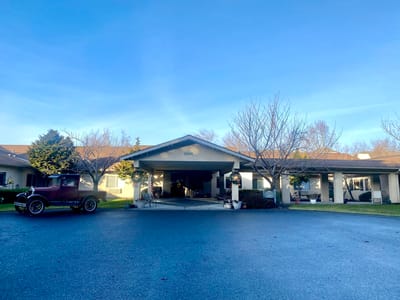
The license at Mt. Baker Care Center in Bellingham, WA, covers skilled nursing, respite care, assisted living, palliative care, and nursing home care. The building stands in the South Bellingham neighborhood, and at 47 beds, it’s on the small side.
Skilled nursing means licensed nurses working on the premises. Rehabilitation Services and Short-Term Rehab are also on the service list, so a resident’s therapy can happen in the building instead of at another facility.
Every room here is private. Assisted living provides help in that room for specific tasks, such as bathing, getting dressed, or managing medication. Palliative care is a different sort of help, aimed at comfort and at keeping symptoms under control for someone seriously ill.
Respite gets booked by whoever does the caregiving at home, for the duration when they’re traveling or getting over something of their own. With five kinds of care on one license, a resident whose needs change over time can stay put while the care changes around them.
Days can bring group excursions, gardening, sing-alongs, and a Sunday worship service, and Enrichment Activities is a named program on top of that. Nearly everything that reaches the table is cooked from scratch, much of it with locally grown produce.
Most errands mean a car or somebody driving, since 44 on Walk Score counts as car-dependent. The home takes private pay, Medicare, and Medicaid. Nursing time per resident runs to 4 hours and 22 minutes a day, and Catherine Reis-El Bara is the administrator in charge.
Standout metric: Physical therapist is +114% above Washington average
2 of 6 metrics below Washington average
99.8% of staff hours were worked by the facility's own employees
Washington average: 93.8% · Contractors this quarter: Medical Director (1)
Why it matters: employees work here week after week and get to know each resident's routines and needs. Agency contractors often rotate between facilities, so a higher employee share usually means more consistent care.
Smaller home · May offer a more intimate, personalized care environment.
Latest inspection: May 12, 2026 · 1 citation (Abuse/Neglect, moderate), corrected
Most cited category: Quality of Life & Care, 7 of 20 citations · 6 categories in total
Health citations are formal notices following inspections when they fail to comply with safety and care standards.
16 of 20 citations resulted from standard inspections; and 4 of 20 resulted from complaint investigations.
Includes all CMS health inspection records for this property, which could include management/ownership changes.
Data sourced from CMS Health Deficiencies reports. Citation severity codes range from A (least serious) to L (most serious). Immediate Jeopardy (J-L) citations indicate situations where the facility's noncompliance has placed residents at risk of death or serious harm.
Show Inspection ReportsSource: CMS Penalties Database · Data as of Aug 2026
No penalties in the past 3 years
No civil money penalties or payment denials on record since Aug 2023.
How residents at this home fare on health outcomes and preventive care, compared with the Washington average.
13 long-stay measures: 6 better, 5 worse, 2 near WA average
8 short-stay measures: 4 better, 1 near WA average, 3 compared with US only
People who live at the home · 13 measures
Rehab and recovery after a hospital stay · 8 measures
Arrows show whether a figure is above or below the average. Green is better for residents, red is worse, and yellow means within 5% of the average. Grey compares with the US average only, because CMS publishes no state figure. The line on each bar marks the average.
Quality measures are calculated by CMS from Minimum Data Set (MDS) resident assessments and Medicare claims.
59% of new residents, usually for short-term rehab.
39% of new residents, often for short stays.
2% of new residents, often for long-term daily care.
Source: CMS Long-Term Care Facility Characteristics (Data as of Jun 2026)
Residents meet regularly to discuss policies, care quality, and activities
Organized group of residents that meets regularly to discuss facility policies, quality of life, and activities.
Mt. Baker Care Center’s finances from its CMS cost report for the fiscal year ending December 2024, compared with 60 Washington nursing homes that filed a recent report. Includes all financial data for this property, which could include management/ownership changes.
Is it financially stable?
Profitable on care
6.4% operating margin
+2.2 pts vs prior year
Positive margin in 5 of the last 8 reported years. Net income $0.8M after other income.
Does it invest in staff?
Spends less on payroll than most Washington homes
52.0% payroll share of revenue
WA average 64.4%Rank #52 / 60Payroll % of net patient revenue — State benchmarked This nursing home is ranked 52nd out of 60 nursing homes we track in Washington for payroll % of net patient revenue. Shows payroll as a percentage of net patient revenue versus the Washington average, among facilities reporting a recent fiscal year. Below 25% may signal understaffing or heavy agency use — read with Staffing ratings. Communities with the same value for a metric share the same rank. Rankings compare like with like: every nursing home we track in Washington that reports data for that category. Nursing homes without available data are excluded, so the pool size varies from metric to metric.
Payroll fell $0.1M while revenue rose $1.4M. A low share can mean leaner staffing; check hours per resident in the staffing section.
FY 2024 scorecard
Each row shows the FY 2024 figure, the change since the prior report, the trend, and how it compares with Washington homes.
Profitable on care
| Metric | FY 2024 | vs prior year | Trend 2017 → 2024Trend | WA median | Compared with WA homesRank in WA | In short |
|---|---|---|---|---|---|---|
| Net patient revenue What the home earns from resident care, after discounts and bad debt. | $12.4M | +$1.4M | Trend 20172024 | WA median $13.7M | Rank in WA Rank #38 / 60Net patient revenue — State benchmarked This nursing home is ranked 38th out of 60 nursing homes we track in Washington for net patient revenue. Shows this facility's net patient revenue compared to the Washington average, among facilities reporting a recent fiscal year. Higher revenue generally means more resources for staffing and capital — read alongside Payroll %. Communities with the same value for a metric share the same rank. Rankings compare like with like: every nursing home we track in Washington that reports data for that category. Nursing homes without available data are excluded, so the pool size varies from metric to metric. Higher than 37% of homes | Below WA median Higher net patient revenue than 37% of WA homes that filed a recent report. Revenue mostly follows how big a home is. |
| Operating expenses Everything it costs to run the home: staff, supplies, rent, admin. | $11.6M | +$1.1M | Trend 20172024 | WA median — | Rank in WA Not ranked | Within revenue Operating expenses are lower than net patient revenue, so resident care covers its costs. |
| Net patient income Revenue minus operating expenses. Negative means care loses money. | $0.8M | +$0.3M | Trend 20172024 | WA median — | Rank in WA Not ranked | Profit, growing Resident care made money this year, more than in the prior report. |
| Operating margin Net patient income as a share of revenue. The clearest health signal. | 6.4% | +2.2 pts | Trend 20172024 | WA median — | Rank in WA Not ranked | Healthy margin More than 5% of revenue is left after operating expenses. |
| Other income Money not from resident care: investments, grants, services. | $0.0M | — | Trend — | WA median — | Rank in WA Not ranked | Adds to profit Income from outside resident care, on top of the profit from care. |
| Net income The bottom line after other income. | $0.8M | −$1.2M | Trend — | WA median — | Rank in WA Not ranked | Profit The bottom line is above zero after other income. |
Spends less of revenue on staff than most Washington homes
| Metric | FY 2024 | vs prior year | Trend 2017 → 2024Trend | WA median | Compared with WA homesRank in WA | In short |
|---|---|---|---|---|---|---|
| Payroll costs Salaries and wage-related benefits, not counting contract labor. | $6.5M | −$0.1M | Trend 20172024 | WA median $8.4M | Rank in WA Rank #48 / 60Payroll costs — State benchmarked This nursing home is ranked 48th out of 60 nursing homes we track in Washington for payroll costs. Shows total staff payroll — salaries plus wage-related benefits — benchmarked to the Washington average, among facilities reporting a recent fiscal year. Higher payroll relative to peers often signals better staffing and less reliance on contract labor. Communities with the same value for a metric share the same rank. Rankings compare like with like: every nursing home we track in Washington that reports data for that category. Nursing homes without available data are excluded, so the pool size varies from metric to metric. Higher than 20% of homes | Below WA median Higher payroll than 20% of WA homes. Payroll in dollars mostly follows how big a home is, so this compares size, not staffing levels. |
| Payroll share of revenue Payroll divided by revenue. Higher usually means more staff per resident. | 52.0% | −7.1 pts | Trend 20172024 | WA median 58.9% | Rank in WA Rank #52 / 60Payroll % of net patient revenue — State benchmarked This nursing home is ranked 52nd out of 60 nursing homes we track in Washington for payroll % of net patient revenue. Shows payroll as a percentage of net patient revenue versus the Washington average, among facilities reporting a recent fiscal year. Below 25% may signal understaffing or heavy agency use — read with Staffing ratings. Communities with the same value for a metric share the same rank. Rankings compare like with like: every nursing home we track in Washington that reports data for that category. Nursing homes without available data are excluded, so the pool size varies from metric to metric. Higher than 14% of homes | 12.4 pts under WA average The WA average is 64.4% of revenue. Within 3 points of it reads as near the average. |
USD, millions
Net patient revenue Operating expenses Net patient income
% of net patient revenue
Payroll share Operating margin WA payroll average
| Metric | 2017 | 2018 | 2019 | 2020 | 2021 | 2022 | 2023 | 2024 |
|---|---|---|---|---|---|---|---|---|
| Net patient revenue | $8.6M | $8.4M | $8.9M | $8.4M | $9.3M | $9.7M | $11.0M | $12.4M |
| Operating expenses | $8.1M | $8.4M | $8.8M | $8.9M | $9.4M | $9.9M | $10.5M | $11.6M |
| Net patient income | $0.5M | $0.1M | $0.2M | −$0.5M | −$0.1M | −$0.3M | $0.5M | $0.8M |
| Operating margin | 5.5% | 0.9% | 1.7% | −6.2% | −0.6% | −2.8% | 4.2% | 6.4% |
| Net income | $0.5M | $0.1M | $0.2M | $0.1M | $1.1M | $0.8M | $2.0M | $0.8M |
| Payroll costs | $3.4M | $3.9M | $4.2M | $4.1M | $4.3M | $5.0M | $6.5M | $6.5M |
| Payroll share of revenue | 39.8% | 46.0% | 47.3% | 48.8% | 46.4% | 51.6% | 59.1% | 52.0% |
| Beds | 70 | 70 | 70 | 70 | 70 | 70 | 70 | 70 |
| Gross revenue | $10.8M | $10.1M | $10.7M | $9.8M | $10.9M | $11.1M | $12.9M | $14.5M |
| Salaries | $3.4M | $3.9M | $4.2M | $4.1M | $4.3M | $5.0M | $5.2M | $6.5M |
| Wage-related costs | — | — | — | — | — | — | $1.3M | — |
| Contract labor | — | — | — | — | — | — | — | — |
| Other operating costs | $4.7M | $4.5M | $4.6M | $4.8M | $5.1M | $5.0M | $4.0M | $5.2M |
| Net patient revenue per day | $435 | $417 | $455 | $451 | $477 | $489 | $534 | $613 |
| Cost per day | $411 | $413 | $447 | $479 | $480 | $502 | $512 | $574 |
| Average length of stay | 58.7 days | 76.3 days | 60.9 days | 85.9 days | 81.0 days | 88.4 days | 92.0 days | 79.1 days |
Showing 2024–2022 · scroll sideways for 5 earlier years
Earlier and partial years are in the download. Download CSV
Most residents typically stay for a few weeks or months before returning home or moving on.
Most new residents arrive under Medicare (59% of admissions), and a typical Medicare stay runs around 28 days.
Coverage residents most often arrive under.
Coverage residents most often leave under.
Catherine Reis-El Bara has been the Administrator at Mt. Baker Care Center since 2014, bringing 25 years of long-term care experience, including 18 years as a facility Administrator. She oversees all facility operations, compliance, staff management, and financial reporting, ensuring quality care for residents.
3.4 miles from city center
Estimated distance in miles from Bellingham's city center to Mt. Baker Care Center's address, calculated via Google Maps.
Add your location
Mt. Baker Care Center is located in Bellingham, Washington State.
Here are the financial assistance programs available to residents in Washington State.
Mt. Baker Care Center is in the South Bellingham neighborhood of Bellingham.
Mt. Baker Care Center has a walk score of 44. Car-dependent. A few nearby services may be reachable on foot, but most trips require transportation.
According to WA state health department records, Mt. Baker Care Center's license number is 1606.
Mt. Baker Care Center's occupancy is 79.0%.
No, Mt. Baker Care Center has a no-pet policy.
Mt. Baker Care Center is registered as a for-profit in WA.
Mt. Baker Care Center received a 5-star overall rating from the CMS (Centers for Medicare and Medicaid Services). This score combines results from staffing levels, quality measures, and health inspections.
Care Cost Calculator: See Prices in Your Area
Nursing Home Data Explorer
Don’t Wait Too Long: 7 Red Flag Signs Your Parent Needs Assisted Living Now
The True Cost of Assisted Living in 2025 – And How Families Are Paying For It
Understanding Senior Living Costs: Pricing Models, Discounts & Financial Assistance