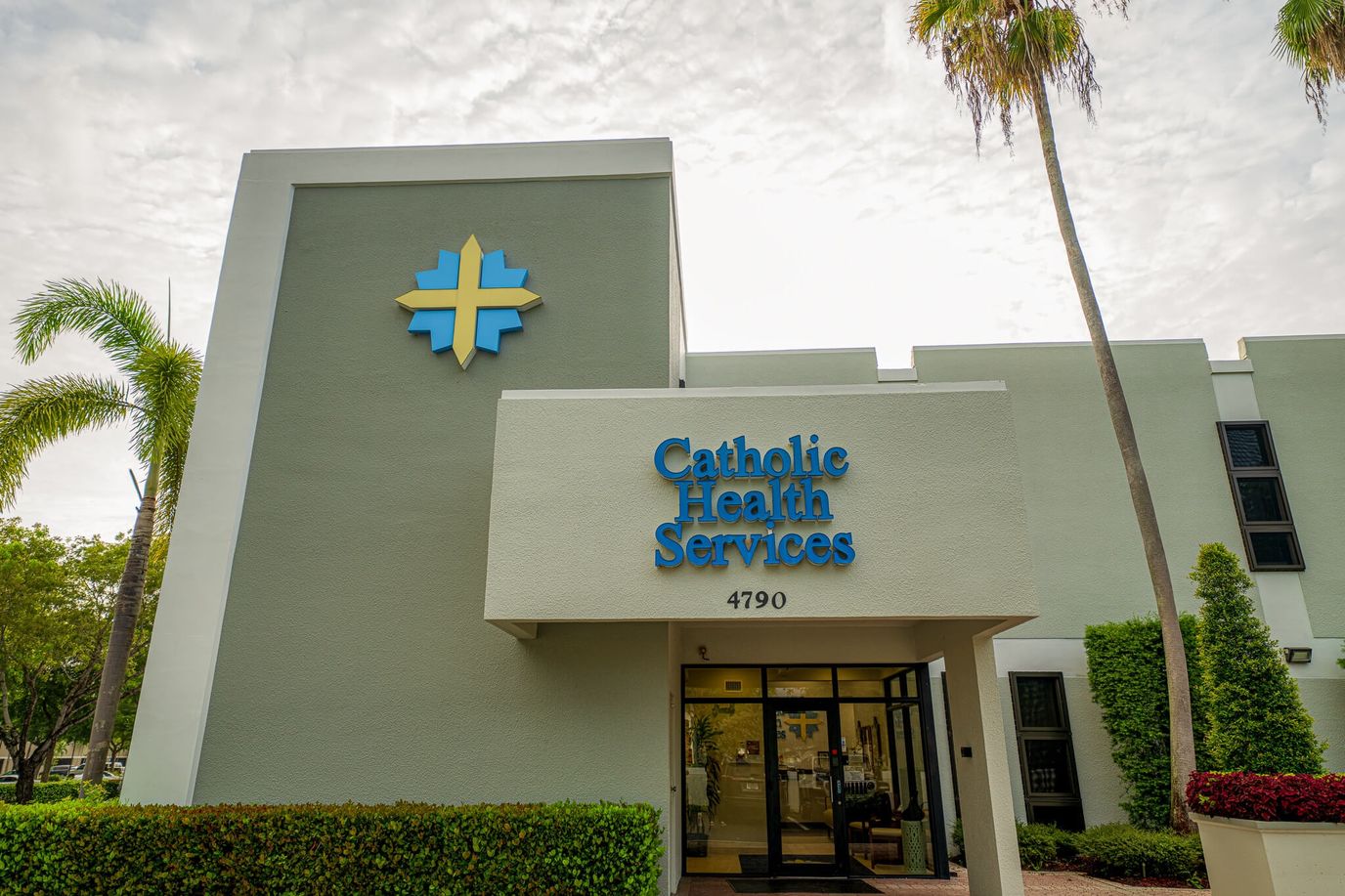


Catholic Hospice – Broward Office
Catholic Hospice, Broward Office provides home care and hospice care in Lauderdale Lakes, in the Tamarac neighborhood. Home care supports a person in their own residence, while hospice care focuses on comfort and support at the end of life. The services may be a good fit for someone who needs care at home or hospice support.
The office has private rooms. It is housed in a two-story building.
Community insights.
About This Community
Places of interest near Catholic Hospice – Broward Office
1.5 miles from city center
Estimated distance in miles from Lauderdale Lakes's city center to Catholic Hospice – Broward Office's address, calculated via Google Maps.
Calculate Travel Distance to Catholic Hospice – Broward Office
Add your location
Programs that may help with care and living costs in Florida
Catholic Hospice – Broward Office is in Lauderdale Lakes, Florida. These programs may support different care settings or living expenses. A listing does not confirm this community participates; our concierge team can help confirm.
Long-Term Care Waiver
Florida Statewide Medicaid Managed Care Long-Term Care (SMMC LTC)
- Income limit
- 2026 · The 2026 individual ICP/HCBS income standard is $2,982/month; trust and spousal rules require individualized review.
Eligibility
- General
- Medicaid-eligible adults age 65+ or adults age 18+ eligible because of disability who meet the required nursing-facility or qualifying hospital level of care.
- FL specifics
- DOEA assesses medical eligibility and DCF determines financial eligibility; managed-care enrollment and assessed need determine services.
What it provides
- Authorized long-term-care services through the SMMC LTC plan; specific hours and respite benefits depend on the care plan.
Optional State Supplementation (OSS)
Florida Optional State Supplementation
- Income limit
- 2026 · January 2026 individual income limits vary by category: $1,072.40 redesign; $1,179 protected. Couple limits and income deductions differ.
- Asset limit
- $2,000 for one person or $3,000 for a couple under the January 2026 OSS standards.
Eligibility
- General
- Eligible older, blind or disabled Florida residents in qualifying non-institutional residential settings who meet OSS financial and other requirements.
- FL specifics
- Redesign and protected categories use different provider-payment and subsidy standards; DCF determines the applicable category.
What it provides
- Monthly residential-support supplement based on countable income; individual maximum is $184.40 redesign or $345 protected under the January 2026 table; $160 personal-needs allowance.
Community Care for the Elderly (CCE)
Florida CCE
Eligibility
- General
- Florida residents age 60+ with assessed functional impairment who need community support.
- FL specifics
- A needs assessment determines service priority; Adult Protective Services referrals involving abuse, neglect or exploitation receive priority.
What it provides
- Assessed community services such as home support; meals; respite; adult day care and transportation; subject to the local care plan and funding.
Home Care for the Elderly (HCE)
Florida Home Care for the Elderly
- Income limit
- Income must meet the Institutional Care Program standard used for HCE eligibility.
- Asset limit
- Applicable Institutional Care Program resource standards apply.
Eligibility
- General
- Adults age 60+ at risk of nursing-home placement living in a private family setting with an approved adult live-in caregiver.
- FL specifics
- Caregiver approval and a case-managed plan are required; this is distinct from CCE and Medicaid LTC.
What it provides
- Basic subsidy of $160/month; additional special subsidies for approved needs may be available without a universal fixed amount.
Alzheimer’s Disease Initiative
Florida Alzheimer’s Disease Initiative (ADI)
Eligibility
- General
- Dementia caregiver support and temporary respite for adults age 18+ with diagnosed or suspected Alzheimer’s/related dementia affecting daily activities, assessed through Florida’s aging network.
- FL specifics
- Clients cannot also enroll in a Medicaid capitated long-term-care program. Funding, priority assessment, service requirements and copayment rules apply.
What it provides
- Authorized in-home or facility-based respite; caregiver support and related services. Extended respite may last up to 30 days; this is temporary caregiver relief; not ongoing assisted-living room-and-board coverage.