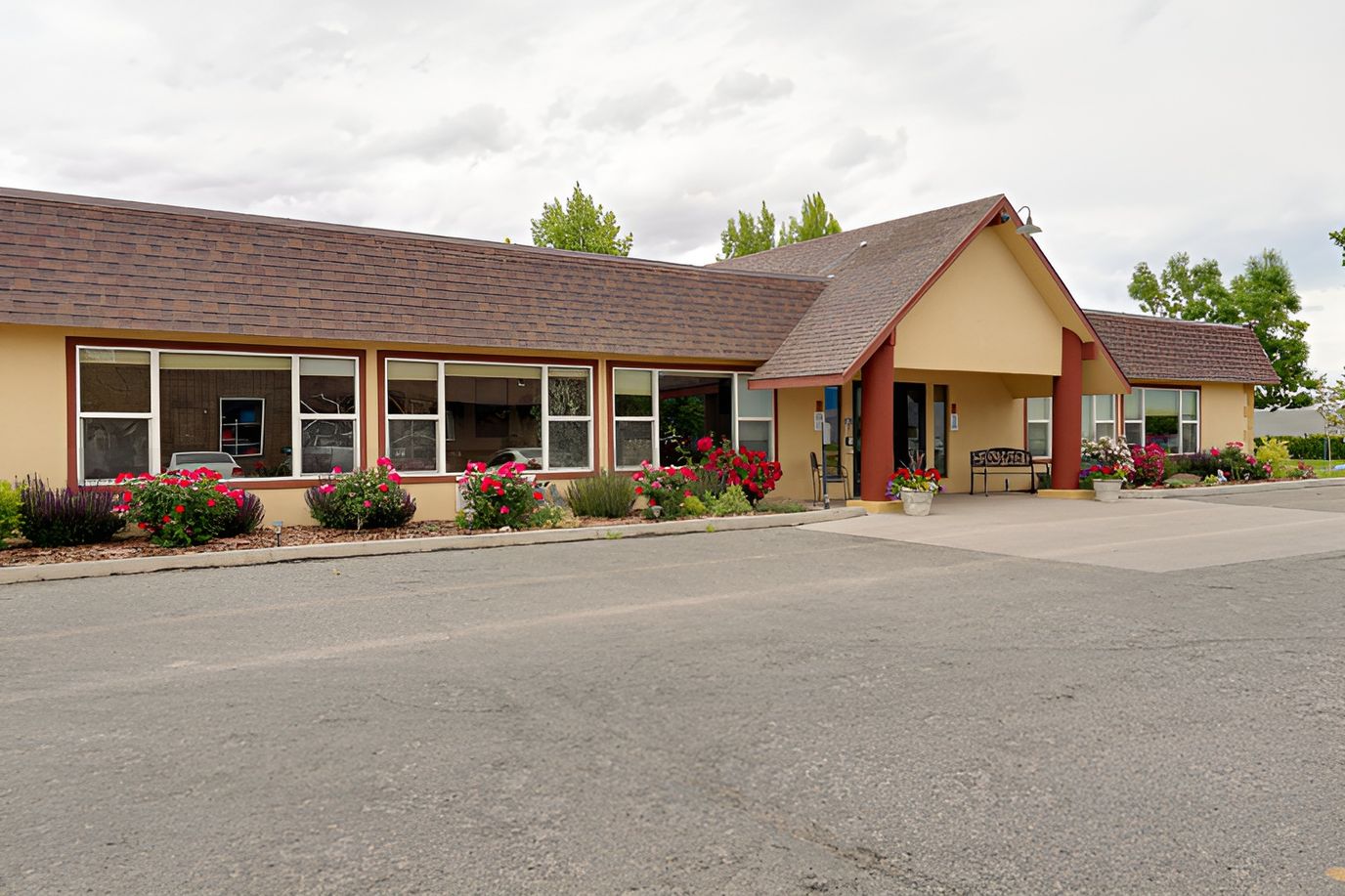



Mission at Richfield Nursing and Rehabilitation
Nursing Home, Assisted Living, Memory Care & Skilled Nursing · Richfield, UT
CMS overall rating Info CMS (the Centers for Medicare & Medicaid Services) is the federal agency that rates nursing home quality. Its Overall Rating runs from 1 to 5 stars, combining health inspections, staffing, and quality measures, with inspections weighted most heavily.

Mission at Richfield Nursing and Rehabilitation

Nursing Home, Assisted Living, Memory Care & Skilled Nursing · Richfield, UT
CMS overall rating Info CMS (the Centers for Medicare & Medicaid Services) is the federal agency that rates nursing home quality. Its Overall Rating runs from 1 to 5 stars, combining health inspections, staffing, and quality measures, with inspections weighted most heavily.
Mission at Richfield Nursing and Rehabilitation accepts Medicare, Medicaid, and private pay.

Overview of Mission at Richfield Nursing and Rehabilitation

Mission at Richfield Nursing and Rehabilitation is a nursing home in North Richfield, UT, offering memory care, skilled nursing, and short-term rehabilitation. With its intimate and home-like setting, the community ensures older adults are treated well during their stay. Exceptional services, including made-to-order dining options, daily housekeeping, laundry, and transportation to medical appointments, are also provided to ease challenges in residents’ daily living. Alongside a wide range of specialized care options, the community also works closely with residents to create individualized care plans.

With a recreational therapist, therapeutic activities and light physical exercises are provided to help residents stay active and gain meaningful experiences. Cozy rooms and thoughtfully furnished amenities ensure residents can recover and rest without worries. Intermountain Health Sevier Valley Hospital and Utah Valley Regional Medical Center are also located nearby, providing easy access to healthcare. As one of the trusted options for senior living in Utah, this nursing home strives to help older adults live to their potential.

Quality ratings

Measured by Centers for Medicare & Medicaid Services (CMS)

Overall rating Info The Overall CMS Rating combines results from health inspections, staffing levels and quality measures. Health inspections carry the most weight. Staffing and quality scores can increase or decrease the final rating based on performance compared to state and national standards.
▲ 15.7% Above UT avg. ▲ 15.7% Above UT avg.UT average: 3.5Click the badge to see the full State ranking.Click here to see the full State ranking.
Health Inspection Info Based on the results of the facility's three most recent standard inspections and any complaint investigations. CMS reviews the number, scope, and severity of deficiencies, with more recent findings weighted more heavily.
▲ 43.1% Above UT avg. ▲ 43.1% Above UT avg.UT average: 2.8Click the badge to see the full State ranking.Click here to see the full State ranking.
Staffing Info Measures average nursing staff hours per resident per day, including Registered Nurses (RNs) and total nursing staff. Ratings are adjusted based on the level of care residents require and are compared to state and national benchmarks.
▼ 68.7% Below UT avg. ▼ 68.7% Below UT avg.UT average: 3.2Click the badge to see the full State ranking.Click here to see the full State ranking.
Quality Measures Info Based on clinical and physical health indicators reported to CMS, such as hospital readmissions, falls, pressure ulcers, and improvements in mobility. These measures reflect how well residents' health needs are being managed.
▲ 8.0% Above UT avg. ▲ 8.0% Above UT avg.UT average: 4.6Click the badge to see the full State ranking.Click here to see the full State ranking.

Staffing Info Nursing care per resident per day and state rankings: CMS Provider Information.

Total nursing care per resident / day Info This nursing home is ranked 65th out of 74 nursing homes we track in Utah for nurse hours. Total adjusted nursing hours per resident per day, combining RN, LPN, and aide time. CMS adjusts this for case-mix so facilities can be fairly compared.
↓ 23% · UT 3h 49mThis facility: 2h 56m per resident per day, 23% below the Utah average of 3h 49m (among Utah facilities reporting a recent figure).Green: 5% or more better than the state average. Yellow: within 5%. Red: 5% or more worse. Rank #65 / 74Nurse hours — State benchmarked This nursing home is ranked 65th out of 74 nursing homes we track in Utah for nurse hours. Shows adjusted nurse hours per resident per day benchmarked to the Utah average, with a ranking across 74 Utah facilities. More hours mean more direct care. The national average is about 3.5 hrs; below 3.0 is a red flag. Communities with the same value for a metric share the same rank. Rankings compare like with like: every nursing home we track in Utah that reports data for that category. Nursing homes without available data are excluded, so the pool size varies from metric to metric.
2h 56m

6 of 6 metrics below Utah average

By The Numbers

Community insights.

Walk Score Info Car-dependent. A few nearby services may be reachable on foot, but most trips require transportation. Rank #67 / 81Walk Score — State benchmarked This nursing home is ranked 67th out of 81 nursing homes we track in Utah for walk score. Shows how walkable this facility's neighborhood is compared to the average walk score across Utah facilities. Higher scores benefit residents, families, and staff. Communities with the same value for a metric share the same rank. Rankings compare like with like: every nursing home we track in Utah that reports data for that category. Nursing homes without available data are excluded, so the pool size varies from metric to metric.
26 / 100
Residents per day (avg) Info The average number of residents living at this facility on a given day. CMS calculates this figure from the facility's Minimum Data Set (MDS) assessments and uses this value for other measures like Hours Per Resident Per Day (HPRD) and 5-Star Staffing rating.
39

Source: CMS Provider Information, average daily residents (data as of Oct 2026)

Avg. Length of Stay Info Average number of days residents stay at this facility, based on CMS cost report data. Shorter stays often reflect post-acute or rehab care; longer stays reflect long-term care.
112 days

About This Community

Awards

Best of State in Skilled Nursing Home, 2012, 2013, 2015, 2017, 2019, 2020, 2021

Therapy & Rehabilitation

4 services
Meadow Peak RehabilitationA skilled nursing and rehabilitation facility providing nursing care and therapy after illness, injury, or hospitalization.
Mission at Alpine Rehabilitation CenterA skilled nursing and rehabilitation center providing 24-hour nursing care plus physical, occupational, and speech therapy for recovery or ongoing care.
Mission at Castle Rock Rehabilitation Center
Mission at Community Rehabilitation CenterA Mission Health Services rehabilitation center provides short-term physical, occupational, and speech therapy, often helping older adults recover mobility and return home after illness, injury, or surgery.

Additional Services

3 services
Housekeeping
Laundry & Linen
Beauty Services

Additional Policies & Features

Pets not allowed
Admission CriteriaMust be ambulatory or mobile, capable of taking life saving action in an emergency, and have stable health.

Amenities & Lifestyle

Private Dining Room

Room Accommodations

Building TypeSingle-story
Room Types
Private Rooms

Contact Mission at Richfield Nursing and Rehabilitation

Enforcement

Penalties and fines About penalties and fines Federal penalties imposed by CMS for regulatory violations, including civil money penalties (fines) and denials of payment for new Medicare/Medicaid admissions.

Source: CMS Penalties Database · Data as of Oct 2026

No penalties in the past 3 years

No civil money penalties or payment denials on record since Oct 2023.

Clean record
Total fines
$0 UT avg $48KUtah average: $48,183. Average among the 48 Utah facilities with a penalty on record.US avg $66KUS average: $66,281, among the 6,725 US facilities with a penalty on record.
Number of fines
0 UT avg 1.67Utah average: 1.67. Average among the 48 Utah facilities with a penalty on record.US avg 1.88US average: 1.88, among the 6,725 US facilities with a penalty on record.
Payment denials What is a payment denial? Serious action where Medicare and/or Medicaid temporarily stops payments for new residents until issues are fixed.
0 UT avg 0.27Utah average: 0.27. Average among the 48 Utah facilities with a penalty on record.US avg 0.35US average: 0.35, among the 6,725 US facilities with a penalty on record.

Finances and operations

Based on CMS SNF Cost Report for fiscal year ending in 06/2025.

Government
Operated by county authorities.
Net patient revenue Info Net patient revenue — what the home actually collects for resident care, after contractual allowances, bad debt and discounts are subtracted from its gross charges (CMS cost report, Worksheet G-3). It covers resident care only; money the home earns from other sources is shown separately as "Other income."
$3.9MFiscal year ending 06/2025
Net patient income Info Net patient income: net patient revenue minus the home's total operating expenses. A positive figure means it earns more from resident care than it spends to deliver it; a negative figure means the opposite. It excludes non-operating "other income."
-$718.5KFiscal year ending 06/2025
Government Operated by county authorities.
Net patient revenue Info Net patient revenue — what the home actually collects for resident care, after contractual allowances, bad debt and discounts are subtracted from its gross charges (CMS cost report, Worksheet G-3). It covers resident care only; money the home earns from other sources is shown separately as "Other income."
$3.9MFiscal year ending 06/2025 Rank #69 / 70Net patient revenue — State benchmarked This nursing home is ranked 69th out of 70 nursing homes we track in Utah for net patient revenue. Shows this facility's net patient revenue compared to the Utah average, among facilities reporting a recent fiscal year. Higher revenue generally means more resources for staffing and capital — read alongside Payroll %. Communities with the same value for a metric share the same rank. Rankings compare like with like: every nursing home we track in Utah that reports data for that category. Nursing homes without available data are excluded, so the pool size varies from metric to metric.
Net patient income Info Net patient income: net patient revenue minus the home's total operating expenses. A positive figure means it earns more from resident care than it spends to deliver it; a negative figure means the opposite. It excludes non-operating "other income."
-$718.5KFiscal year ending 06/2025
Other income Info Money the home earns outside of resident care — such as investments, grants, rentals and other non-operating sources (CMS cost report, Worksheet G-3). It is tracked separately from net patient revenue: it is not part of that figure, and it is not included in net patient income.
$353.4KFiscal year ending 06/2025
Payroll costs Info Staff salaries plus wage-related costs — benefits such as payroll taxes, health insurance and retirement — from the home's own accounting records (CMS cost report, Worksheet A). Contract or agency labor is counted separately, under other operating costs. Rank #66 / 70Payroll costs — State benchmarked This nursing home is ranked 66th out of 70 nursing homes we track in Utah for payroll costs. Shows total staff payroll — salaries plus wage-related benefits — benchmarked to the Utah average, among facilities reporting a recent fiscal year. Higher payroll relative to peers often signals better staffing and less reliance on contract labor. Communities with the same value for a metric share the same rank. Rankings compare like with like: every nursing home we track in Utah that reports data for that category. Nursing homes without available data are excluded, so the pool size varies from metric to metric.
$1.9MFiscal year ending 06/2025 49.6% of net patient revenue Info Payroll as a share of revenue: staff salaries and wage-related benefits divided by net patient revenue. A higher figure means more of each revenue dollar goes to staff pay. Rank #34 / 68Payroll % of net patient revenue — State benchmarked This nursing home is ranked 34th out of 68 nursing homes we track in Utah for payroll % of net patient revenue. Shows payroll as a percentage of net patient revenue versus the Utah average, among facilities reporting a recent fiscal year. Below 25% may signal understaffing or heavy agency use — read with Staffing ratings. Communities with the same value for a metric share the same rank. Rankings compare like with like: every nursing home we track in Utah that reports data for that category. Nursing homes without available data are excluded, so the pool size varies from metric to metric.
Other operating costs Info Everything it costs to run the home apart from payroll — food, utilities, supplies, maintenance, contract labor and administration. Calculated as total operating expense minus payroll (staff salaries and wage-related benefits).
$2.7MFiscal year ending 06/2025
Total costs Info The home's total operating expense for the year — all the costs of running it, salaries included (CMS cost report, Worksheet G-3).
$4.6MFiscal year ending 06/2025

Who this home usually serves

Residents split by who pays for their care: Medicare, Medicaid, or private pay and other sources.
Over a year: CMS SNF Cost Report, FY2025
Arriving
103 admissions · FY2025 Residents admitted during the year.
Medicare 15 · 15%
Medicaid 35 · 34%
Private pay & other 53 · 51%
Shows care patterns over time; not used to rate this facility.

Mix of rehab and long-term care

This home supports both short-term rehab and long-term care, with residents staying for a wide range of durations.

Typical stay

Medicare 1 month Medicaid 8 - 9 months Private pay & other 1 - 2 months

Places of interest near Mission at Richfield Nursing and Rehabilitation

Address 0.8 miles from city center Info Estimated distance in miles from Richfield's city center to Mission at Richfield Nursing and Rehabilitation's address, calculated via Google Maps.

Calculate Travel Distance to Mission at Richfield Nursing and Rehabilitation

Add your location

Address

Compare Nursing Homes around Richfield

Info below is compiled from CMS reports & the UT Dept. of Health & Human Services (DHHS), senior community websites & trusted data sources such as Walk Score & BBB.

Communities are listed from highest-ranked to lowest-ranked based on our methodology.

The facility name. Click to view the full profile page on Assisted Living Magazine, including photos, services, and contact info.
CMS (Centers for Medicare & Medicaid Services, the federal agency that regulates nursing homes) Overall 5-star rating — a composite of Health Inspection, Staffing, and Quality Measures scores. 5 stars = top 10% nationally. 1 star = bottom 10%. The single most important number to start with when comparing facilities.
Care Types in This Table AL (Assisted Living): Housing with help for daily activities like bathing, dressing, and medication, without 24-hour skilled nursing. NH (Nursing Home): 24/7 skilled nursing care for residents with complex, ongoing medical needs. SNF (Skilled Nursing Facility): Round-the-clock nursing care, often for recovery after surgery, injury, or illness. MC (Memory Care): Secured, specialized care for people living with Alzheimer's or dementia.
Neighborhood or city area where the facility is located. Proximity to family, hospitals, and green space matters for both quality of life and ease of visitation. Consider drive time and transit access when evaluating location.
Licensed bed capacity. Larger facilities (300+ beds) often have more specialized programs but can feel institutional. Smaller homes (under 150 beds) tend to deliver more personalized care. Compare with Avg Res/Day to understand how full the facility typically runs.
Percentage of licensed beds filled on an average day. Color indicates financial health: green (90%+) = operationally strong, typically profitable. Amber (80–89%) = stable but leaving revenue on the table. Orange (70–79%) = financial strain likely, may struggle with fixed costs. Red (
This facility's occupancy rate compared to the statewide average for similar facilities. A positive number means above-average demand. Facilities running 5%+ above the state average are typically the most sought-after in their market — a strong proxy for reputation.
CMS-adjusted total nurse hours per resident per day (RN + LPN + CNA combined). The national average is approximately 3.5 hrs. Higher is better — more direct care time per resident. Below 3.0 is a red flag. CMS weights RN hours more heavily because RNs handle complex clinical decisions that CNAs cannot.
CMS Health Inspection star rating (1–5 stars), based on the 3 most recent annual state surveys plus any complaint investigations. This is the hardest rating to manipulate — it reflects real surveyor findings on-site. 5 stars = fewest deficiencies found. 1 star = most. It carries the heaviest weight in the Overall CMS rating.
CMS Staffing star rating (1–5 stars), based on daily nurse staffing hours submitted to CMS via verified payroll data. Compares RN, LPN, and CNA coverage relative to resident acuity level. 5 stars = well above expected staffing. Weekend staffing is evaluated separately, as that's where many facilities quietly reduce coverage.
CMS Quality Measures star rating (1–5 stars), based on 15 clinical outcome metrics including fall rates, pressure ulcers, antipsychotic drug use, and hospital readmissions. Captures actual resident health outcomes, not just compliance. High QM combined with low Health Inspection scores can indicate a facility with strong care but weak documentation practices.
Registered Nurse hours per resident/day compared to the statewide average. RNs are the highest-skilled nursing staff — they assess residents, manage medications, and respond to emergencies. A value of +50% means RN coverage is 50% above the state norm. Negative values are a concern for residents with complex or acute medical needs.
Total nursing staff hours (RN + LPN + CNA combined) per resident/day vs. the statewide average. A broader measure than RN vs State — it captures the entire care team. A facility can have high total staffing but low RN hours, meaning more aides and fewer nurses. Read both columns together for the full picture.
Total dollar amount of federal monetary fines (civil money penalties) issued by CMS in the past 3 years. Fines are only levied for serious violations — typically actual harm to residents, repeated uncorrected deficiencies, or systemic non-compliance. Even a single fine is noteworthy. Multiple fines strongly suggest a pattern, not isolated incidents.
Total health deficiency citations from the most recent standard inspection cycle. Minor citations (scope A–C) are common and often administrative in nature. Higher counts aren't always disqualifying, but should be read alongside Severe Citations to understand actual harm levels. Under 10 is strong for a large facility; 30+ warrants a closer look.
Average deficiency citations per CMS inspection (survey) in the reporting window — total citations divided by the number of inspections. Lower is better; compare alongside total Citations and Severe Citations for context.
Citations at CMS scope/severity level G or higher — G–I means actual harm occurred; J–L means residents were placed in immediate jeopardy. (D–F is potential for harm only). Examples include unaddressed falls, medication errors causing injury, neglect, or abuse.
Average number of residents in the building on any given day, derived from annual census data. Reflects true operating scale — a 400-bed facility running 200 residents/day operates very differently from one at 390. Higher resident counts generally mean more funded staffing hours.
Better Business Bureau rating (A+ to F). Reflects complaint history, business transparency, and how family disputes were resolved. A+ means no significant unresolved complaints. A blank (—) means the facility isn't BBB-accredited, which is common for healthcare providers and not necessarily a negative signal.
Walk Score® (0–100). Measures walkability of the surrounding area. 90–100 = Walker's Paradise. 70–89 = Very Walkable. 50–69 = Somewhat Walkable. Below 50 = Car-Dependent. Higher scores benefit family visitors, resident outings, and staff commuting.
The licensed owner or operator of record filed with CMS — the individual or organization legally accountable for the facility. Searching the operator name across other facilities can reveal chain or multi-site ownership, which matters: chain-operated homes tend to have more variable quality outcomes than independently run facilities.
What the home actually collects for resident care, after contractual allowances, bad debt and discounts — not gross billings. Taken from the latest complete annual cost report, so it is comparable across homes reporting the same period. Revenue alone doesn't indicate care quality, but it funds staffing and capital reinvestment. Pair with Payroll %. Figures are from each facility's most recent complete fiscal year — hover a value for the exact year; a * marks homes that report an older period than most facilities.
Staff salaries plus wage-related benefits from the latest complete annual cost report. Contract and agency labour is counted separately, under other operating costs, so a home leaning on agency staff can show a low figure here. Payroll is the cost most directly tied to care quality — compare with Payroll % for full context. Figures are from each facility's most recent complete fiscal year — hover a value for the exact year; a * marks homes that report an older period than most facilities.
Payroll as a share of NET PATIENT REVENUE (not gross revenue). Both figures come from the same cost-report year. A higher figure means more of each revenue dollar goes to staff pay. Read with the Staffing star rating to judge whether spend translates into coverage — and note that homes whose patient revenue covers only part of their operation can read implausibly high. The Utah average is: 51.2% Figures are from each facility's most recent complete fiscal year — hover a value for the exact year; a * marks homes that report an older period than most facilities.
CMS Certification Number: the unique federal identifier for this skilled nursing provider.
Sandstone Richfield ★ ★ ★ ★ ☆
NH
MC
SNF
Richfield
98
Facility 98
UT AVG 94
Rank #36 / 73
39.8%
Facility 39.8%
UT AVG 71.3%
Rank #61 / 66
-44%
2.94
Facility 2.94
UT AVG 3.81
Rank #65 / 74
★ ★ ★ ★ ☆ ★ ☆ ☆ ☆ ☆ ★ ★ ★ ★ ★ -42%-23%
$8.1k
Facility $8.1k
UT AVG $48.0k
Rank #36 / 74
14
Facility 14
UT AVG 26.5
Rank #13 / 73
4.7
Facility 4.7
UT AVG 7.5
Rank #17 / 73
139-
26
Facility 26
UT AVG 52
Rank #67 / 81
Richfield Nursing & Rehab LLC
$3.9MFiscal year ending 06/2025
Facility $3.9MFiscal year ending 06/2025
UT AVG $9.5M
Rank #69 / 70
$1.9MFiscal year ending 06/2025
Facility $1.9MFiscal year ending 06/2025
UT AVG $4.7M
Rank #66 / 70
49.6%Fiscal year ending 06/2025
Facility 49.6%Fiscal year ending 06/2025
UT AVG 51.2%
Rank #34 / 68
465059
Mission at Community Rehab Centerfield ★ ★ ★ ★ ☆
NH
AL
MC
SNF
S Centerfield
46
Facility 46
UT AVG 94
Rank #62 / 73
89.8%
Facility 89.8%
UT AVG 71.3%
Rank #13 / 66
+26%
3.03
Facility 3.03
UT AVG 3.81
Rank #59 / 74
★ ★ ★ ☆ ☆ ★ ★ ★ ☆ ☆ ★ ★ ★ ★ ★ 0%-20%
$0
Facility $0
UT AVG $48.0k
Rank #1 / 74
20
Facility 20
UT AVG 26.5
Rank #27 / 73
6.7
Facility 6.7
UT AVG 7.5
Rank #34 / 73
-41--Care Transitions Inc
$5.2MFiscal year ending 06/2025
Facility $5.2MFiscal year ending 06/2025
UT AVG $9.5M
Rank #60 / 70
$0.0kFiscal year ending 06/2025
Facility $0.0kFiscal year ending 06/2025
UT AVG $4.7M
Rank #69 / 70
0%Fiscal year ending 06/2025465175

Rank badges are statewide and care-type specific: each nursing home is ranked against every other UT nursing home we track that reports that metric, not just the 2 on this page. See how we rank facilities

Financial assistance

Programs that may help with care and living costs in Utah

Mission at Richfield Nursing and Rehabilitation is in N Richfield, Utah. These programs may support different care settings or living expenses. A listing does not confirm this community participates; our concierge team can help confirm.

Get financial aid guidance
Cash support · veterans

VA Aid and Attendance (A&A) and Housebound Benefits

Utah VA Aid and Attendance/Housebound

Who it is for
Veterans or survivors with VA pension eligibility and an Aid and Attendance or Housebound medical need
Income limit
Countable income must be below the applicable Maximum Annual Pension Rate (MAPR); the rate depends on dependents and benefit category; Qualifying unreimbursed medical expenses may reduce countable income.
Asset limit
VA pension net-worth limit is $163,699 from December 1 2025 through November 30 2026; net worth includes countable assets and annual income under VA rules.

Eligibility

General
Additional pension benefits for qualifying Veterans or survivors who satisfy VA pension eligibility and the medical requirements for Aid and Attendance or Housebound status; being an older veteran or spouse alone does not qualify.
UT specifics
This is a federal VA benefit rather than a state-specific grant; Aid and Attendance and Housebound benefits cannot be received together.

What it provides

  • Increased monthly VA pension based on the applicable MAPR less countable income.
In-home and community residential support

New Choices Waiver

Utah New Choices Waiver

Eligibility

General
Age 18 or older, meeting Utah Medicaid financial rules and nursing-facility level of care. Applicants need a qualifying prior facility stay or an eligible transfer from another Utah HCBS waiver with an immediate or impending nursing-facility need.
UT specifics
Qualifying pathways include at least 90 days of Medicaid-paid nursing-facility care; at least 30 days of Medicare-paid institutional care with a planned additional nursing-facility stay of at least 60 days; or at least 365 days in assisted living or a Type N facility. Primary mental illness, intensive skilled-care needs and ICF/ID eligibility are excluded. Slots are limited.

What it provides

  • Assessed support may include attendant care or adult residential services and community transition support.
  • Other authorized services may include respite and home modifications.
  • Participants pay their own shelter costs including room and board.
In-home & community support

Aging Waiver

UT Medicaid Aging Waiver

Income limit
Aging Waiver Medicaid financial rules must be assessed individually.

Eligibility

General
Utah resident age 65 or older who is financially eligible for Medicaid and requires nursing-facility level of care.
UT specifics
Enrollment is limited; covered services must be assessed as needed and approved in the service plan.

What it provides

  • Assessed personal assistance adult day health respite home-delivered meals homemaker services transportation emergency response and other approved waiver supports.
In-home support

Utah Alternatives Program

UT Alternatives

Eligibility

General
Utah Alternatives provides individualized in-home support for low-income aging adults; detailed clinical and local intake criteria require assessment.
UT specifics
Contact the local Area Agency on Aging for assessment and service availability.

What it provides

  • Individually planned in-home assistance.
In-home & community support

Older Americans Act (OAA) Services

Utah OAA Services

Who it is for
Adults 60+ looking for meals, in-home help or other local aging services
Income limit
OAA nutrition services have no income means test; priority is directed to people with greatest economic or social need.
Asset limit
OAA nutrition eligibility is not asset-tested.

Eligibility

General
Older Americans Act supportive and nutrition services generally serve adults age 60 or older; individual services can have additional criteria and specified exceptions.
UT specifics
Utah Aging and Adult Services identifies home-delivered and congregate meals transportation information and referral and other locally administered supports; contact the local Area Agency on Aging.

What it provides

  • Locally available nutrition and supportive services may include meals and in-home assistance.
Caregiver support

Utah Caregiver Support Program

Utah Family Caregiver Support Program (FCSP)

Eligibility

General
Unpaid caregivers of older adults and people with dementia or disabilities and older adults caring for minor children may qualify; eligibility is program-specific.
UT specifics
State program offers caregiver resources education and support through local providers.

What it provides

  • Caregiver information counseling training support groups respite and assistive supplies as locally available.
Medicare costs

Medicare Savings Program (MSP)

Utah Medicare Savings Program

Who it is for
Medicare beneficiaries with limited income who need help with premiums or cost sharing
Asset limit
2026 · QMB SLMB and QI countable-resource maximum $9,950 individual or $14,910 couple; exclusions apply.

Eligibility

General
Utah Medicare beneficiary meeting eligibility for QMB SLMB or QI; age 65 is not a universal prerequisite for Medicare-related coverage.
UT specifics
QMB pays qualifying Medicare premiums and cost sharing; SLMB and QI provide Part B premium assistance.

What it provides

  • Tier-specific Medicare premium and cost-sharing assistance.
Energy assistance

Home Energy Assistance Target (HEAT) Program

Utah HEAT Program

Income limit
Household income at or below 150% of the federal poverty level; current dollar limits depend on household size and program year.

Eligibility

General
Eligible low-income Utah households responsible for home energy costs; HEAT is not restricted to older adults.
UT specifics
Year-round energy assistance and energy-related crisis assistance through local offices; amounts and availability are determined by the program.

What it provides

  • Home-energy assistance and eligible energy-crisis assistance.
Know before you visit

Frequently Asked Questions about Mission at Richfield Nursing and Rehabilitation

Quick answers from public records and the community's own listing.
01 Is Mission at Richfield Nursing and Rehabilitation in a walkable area?
Mission at Richfield Nursing and Rehabilitation has a walk score of 26. Car-dependent. A few nearby services may be reachable on foot, but most trips require transportation.
02 What is the occupancy rate at Mission at Richfield Nursing and Rehabilitation?
Mission at Richfield Nursing and Rehabilitation's occupancy is 33.3%.
03 Are pets allowed at Mission at Richfield Nursing and Rehabilitation?
No, Mission at Richfield Nursing and Rehabilitation has a no-pet policy.
04 Is Mission at Richfield Nursing and Rehabilitation a government-operated facility?
Mission at Richfield Nursing and Rehabilitation is a government-operated nursing facility.
05 What is the overall rating for Mission at Richfield Nursing and Rehabilitation?
Mission at Richfield Nursing and Rehabilitation received a 4-star overall rating from the CMS (Centers for Medicare and Medicaid Services). This score combines results from staffing levels, quality measures, and health inspections.
06 Are there photos of Mission at Richfield Nursing and Rehabilitation?
Yes — there are 4 photos of Mission at Richfield Nursing and Rehabilitation in the photo gallery on this page.
07 What levels of care does Mission at Richfield Nursing and Rehabilitation provide?
Mission at Richfield Nursing and Rehabilitation offers Nursing Home, Assisted Living, Memory Care & Skilled Nursing.